
G522
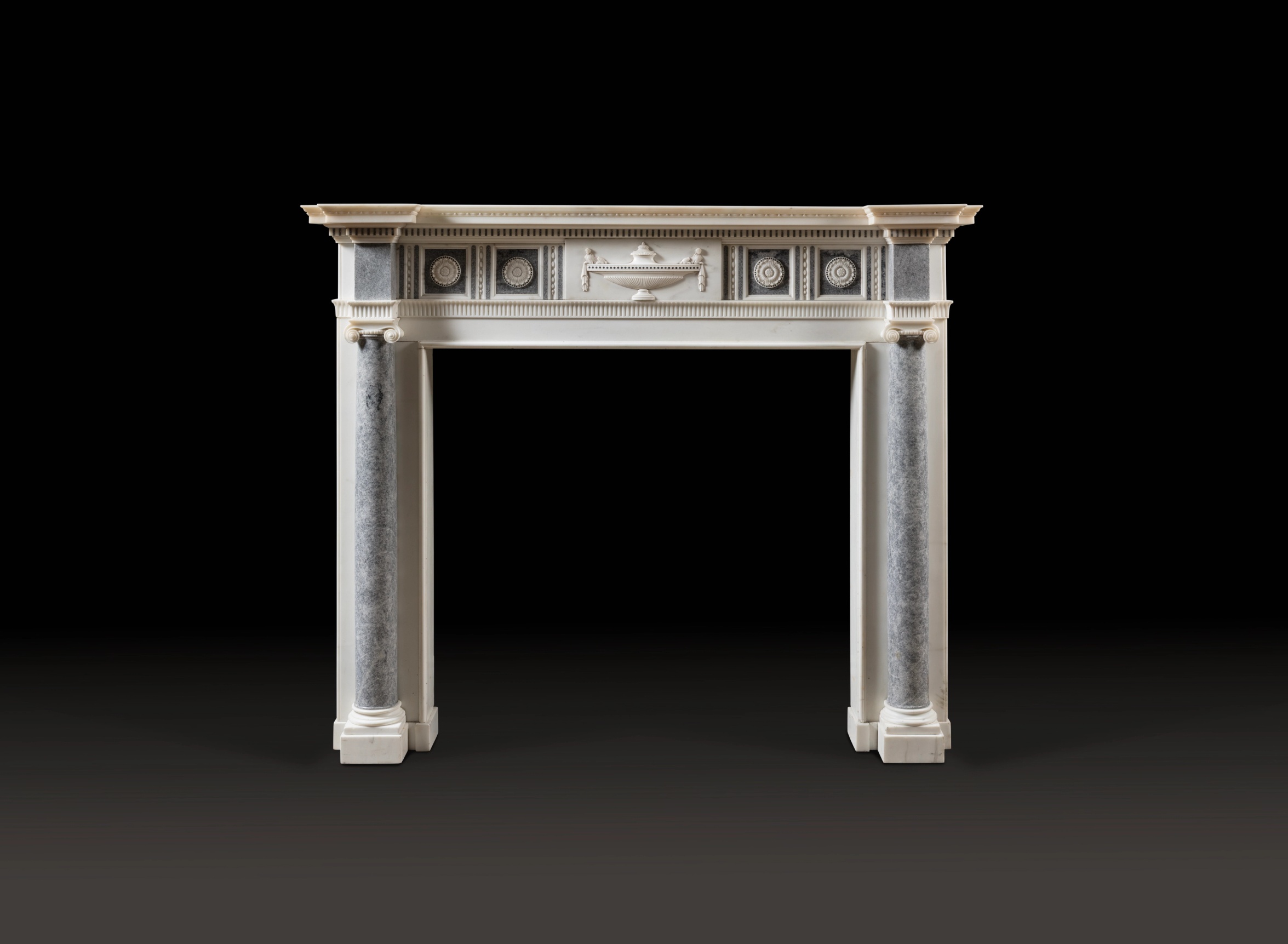
A George III Statuary and Grey English Marble Chimneypiece.
Provenance: By repute from Byram Hall, the seat of the Pennington Ramsden Family.
An 18th century (circa 1775) chimneypiece of exceptional quality, the elegant breakfront shelf supported by an inlaid frieze, showing finely carved paterae and a Classical vase with sphinxes on the central tablet. The three-quarter column pilaster jambs in rare Grey Feldspar marble terminate with Ionic capitals. The fine Neoclassical composition and the provenance of this chimneypiece strongly suggest the attribution of the design to the architect Robert Adam.
Now demolished, Byram Hall in Ferrybridge, near Wakefield, was built in the 16th century and firstly amended during the 17th century, and then again in the last quarter of the 18th century. Its disparate styles were tied together by an austere classical dress provided by John Carr of York (1723-1807), while Robert Adam was summoned to make internal alterations around 1780.
Byram was the oldest seat of the Ramsden family, who were large-scale landowners in South Yorkshire, particularly in the township of Huddersfield, whose development they vigorously promoted, commissioning, in Adam's lifetime, the Huddersfield Cloth Hall (1766) and the Sir John Ramsden Canal (1780). The burgeoning wool textile industry, which drove Huddersfield's boom in the second half of the 18th century, and the simultaneous rise in the Ramsden rental, enabled Sir John Ramsden, 4th Baronet (1755-1839), to turn his mind and means towards the remodelling of Byram Hall and the services of Robert Adam.
Although never a politician of significance, Sir John Ramsden had a parliamentary career as a Rockingham Whig, benefiting from a familial connection with the Prime Minister. He engaged Adam for interior work alone in about 1780. Graphic evidence within the Adam drawings collection now conserved at the Sir John Soane's museum includes his designs for furniture and interior decoration, encompassing the hall, the breakfast room, the dining room, the adjacent passage to the drawing room, the drawing room and the library.
The estate was systematically sold off in the 1920s, with over 2,600 acres of Byram Hall estate going under the hammer on 4-5 July 1922. At this time the house was also dismantled. The date generally accepted for the complete demolition of the main house is 1947, thereby erasing Adam's contribution to Byram Hall.